
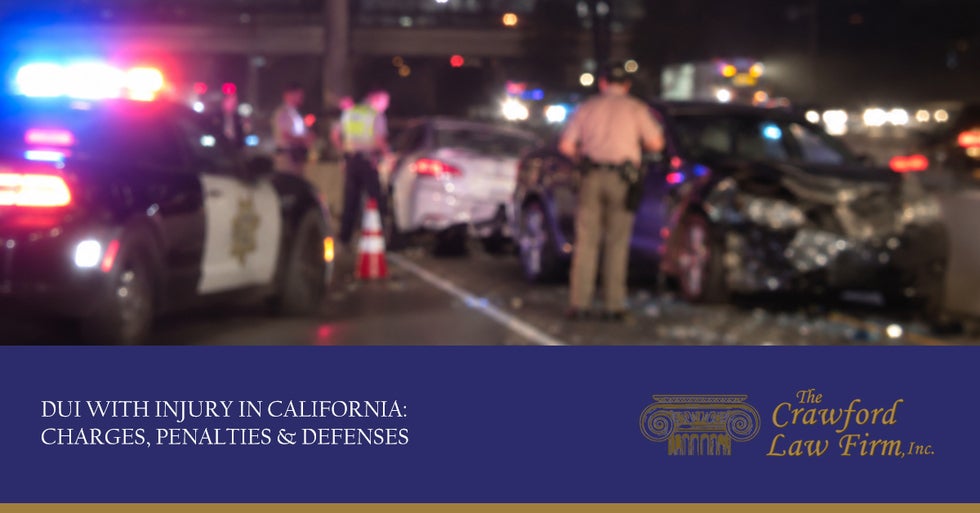
Being arrested for driving under the influence (DUI) in California is a serious matter. However, when an impaired driver is involved in an accident that causes injuries to another person, the legal consequences can become significantly more severe.
Under California Vehicle Code Section 23153, a DUI involving bodily injury can result in misdemeanor or felony charges, substantial fines, driver's license suspension, and potentially years in state prison.
But not every impaired driver involved in an accident in which someone was injured will be convicted of DUI-causing-injury. Prosecutors must prove specific elements of the offense, and legal defenses may be available, depending on the circumstances.
If you or a loved one is facing DUI-with-injury charges in California, understanding the law, potential penalties, and available defense strategies is an important step toward protecting your rights and future.
Quick Highlights
· DUI with injury is covered under California Vehicle Code 23153, which makes it illegal to drive under the influence of alcohol or drugs while committing an unlawful act or failing to perform a legal duty that causes injury to another person.
· DUI causing injury is generally a "wobbler" offense, meaning it can be prosecuted as either a misdemeanor or a felony depending on the circumstances.
· Misdemeanor DUI with injury penalties can include up to one year in county jail, fines, mandatory DUI education, probation, and driver's license suspension.
· Felony DUI with injury penalties can include 16 months, two years, or three years in state prison for a first offense, with additional penalties possible for serious injuries or multiple victims.
· Prosecutors must prove more than impairment and an injury. They must establish that the defendant committed an unlawful act or neglected a legal duty while driving and that the act or neglect caused another person's injury.
· Several legal defenses may be available, including challenging evidence of impairment, disputing who caused the accident, and questioning the accuracy of chemical testing.
What Is DUI With Injury Under California Vehicle Code 23153?
California Vehicle Code Section 23153 makes it illegal to operate a motor vehicle while under the influence of alcohol or drugs and, at the same time, commit an unlawful act or fail to fulfill a legal duty while driving that causes bodily injury to another person.
Unlike a standard DUI charge under Vehicle Code 23152, which does not require an accident or injury, DUI causing injury involves an additional element: another person's injury must have resulted from the driver's unlawful or negligent conduct.
Vehicle Code 23153 includes several different provisions, including:
· VC 23153(a): Driving under the influence of alcohol and committing an unlawful act or neglecting a legal duty that causes bodily injury.
· VC 23153(b): Driving with a blood alcohol concentration (BAC) of 0.08% or higher and committing an unlawful act or neglecting a legal duty that causes bodily injury.
· VC 23153(f): Driving under the influence of drugs and committing an unlawful act or neglecting a legal duty that causes bodily injury.
· VC 23153(g): Driving under the combined influence of alcohol and drugs and committing an unlawful act or neglecting a legal duty that causes bodily injury.
The law also includes provisions involving commercial vehicles and certain vehicles carrying passengers for hire.
Importantly, DUI-with-injury charges are not limited to alcohol impairment. Drivers under the influence of marijuana, prescription medications, illegal drugs, or combinations of substances may also face charges under this law.
What Must Prosecutors Prove in a DUI With Injury Case?
To secure a conviction under California Vehicle Code 23153, prosecutors generally must prove four essential elements beyond a reasonable doubt.
1. The defendant was driving a vehicle.
The prosecution must establish that the accused person was operating the vehicle at the time of the alleged offense.
2. The defendant was under the influence of alcohol or drugs or had a prohibited blood alcohol content.
Depending on the charge, prosecutors must prove that the driver was impaired by alcohol or drugs or had a blood alcohol concentration at or above the applicable legal limit.
3. The defendant committed an unlawful act or neglected a legal duty while driving.
Examples might include speeding, running a red light, failing to yield, following another vehicle too closely, or failing to maintain proper control of the vehicle.
4. The unlawful act or failure to perform a legal duty caused bodily injury to another person.
This final element is especially important. Prosecutors must establish a causal connection between the defendant's unlawful or negligent driving conduct and another person's injuries.
For example, if an intoxicated driver is lawfully stopped at a red light and another motorist crashes into them, the intoxicated driver is not automatically guilty of DUI causing injury simply because someone was hurt.
They could still face a standard DUI charge, but the prosecution would need additional evidence to establish the elements of DUI causing injury.
Is DUI With Injury a Misdemeanor or Felony in California?
One of the most common questions involving DUI with injury charges is whether the offense is classified as a misdemeanor or felony.
In California, DUI causing injury is generally considered a "wobbler", meaning prosecutors have discretion to charge it as either a misdemeanor or felony under many circumstances.
The decision can depend on several factors, including:
· The severity and extent of the victim's injuries
· Whether the driver has previous DUI convictions
· The circumstances surrounding the accident
· The driver's blood alcohol concentration and evidence of impairment
· Whether additional aggravating circumstances were involved
A first-time DUI involving relatively minor injuries may be prosecuted as a misdemeanor. However, an accident involving serious injuries, particularly reckless driving behavior, or previous DUI convictions may be more likely to result in felony charges.
Certain repeat offenses are required to be prosecuted and punished as felonies under California law.
What Are the Penalties for DUI With Injury in California?
The consequences of a DUI with injury conviction depend on whether the charge is a misdemeanor or felony, the defendant's criminal history, and whether additional sentencing enhancements apply.
Misdemeanor DUI With Injury Penalties
For a first DUI causing injury conviction prosecuted as a misdemeanor, potential penalties generally include:
· Jail time: Five days to one year in county jail if probation is granted, or 90 days to one year without probation.
· Fines: A base fine ranging from $390 to $1,000, plus additional penalty assessments and fees.
· Probation: Typically, three to five years, if granted.
· DUI education: Completion of a court-ordered alcohol or drug education program, generally three months for a first offense, with longer programs required in certain circumstances.
· Driver's license suspension: Generally, one year following a first DUI-causing-injury conviction.
A conviction may also involve restitution to injured victims, ignition interlock device requirements, and other conditions.
Felony DUI With Injury Penalties
A felony DUI causing injury conviction carries significantly more serious consequences.
For a first offense, potential penalties can include:
· State prison: A sentencing term of 16 months, two years, or three years if the defendant is sentenced to prison.
· Fines: A base fine of $390 to $1,000, plus applicable assessments and fees.
· Driver's license suspension: Generally, one year for a first conviction, with longer revocation periods for qualifying repeat offenses.
· Additional penalties: Potential sentencing enhancements if multiple victims are injured or a victim suffers great bodily injury.
A felony conviction can also create long-term consequences that extend well beyond the original criminal sentence, potentially affecting employment opportunities, professional licensing, and other aspects of daily life.
Increased Penalties for Repeat DUI Offenses
California also imposes enhanced penalties for individuals with previous qualifying DUI-related convictions.
For example, a DUI causing injury conviction with one qualifying prior DUI offense within 10 years may result in increased minimum jail time, higher fines, and a longer driver's license revocation.
If a driver has two or more qualifying prior DUI-related convictions within the applicable 10-year period, a new DUI-causing-injury offense generally carries a felony prison term of two, three, or four years under Vehicle Code 23566.
Certain prior convictions for DUI without injury and "wet reckless" offenses can also count toward these enhanced penalties.
What Happens if Someone Suffers Serious Injuries?
The severity of an accident victim's injuries can have a substantial impact on the potential penalties in a DUI case.
Under California Penal Code Section 12022.7, a defendant who personally inflicts great bodily injury (GBI) during the commission of a felony may face an additional sentencing enhancement.
Great bodily injury generally means a significant or substantial physical injury.
Examples of injuries that may qualify, depending on their severity and circumstances, include:
- Broken bones or significant fractures
- Serious head or traumatic brain injuries
- Severe internal injuries
- Spinal cord injuries
- Significant injuries requiring hospitalization or surgery
A standard great bodily injury enhancement can add three consecutive years to a felony prison sentence, with different penalties applicable in certain circumstances.
Additionally, under Vehicle Code 23558, a felony DUI with injury conviction involving multiple victims can result in an additional year in prison for each additional injured victim, up to a maximum of three additional years under that provision.
A felony DUI causing injury conviction involving a qualifying great bodily injury finding may also count as a strike under California's Three Strikes Law.
Because sentencing enhancements can substantially increase potential prison time, it is important to carefully examine both the accident evidence and medical documentation in these cases.
What Are Common Legal Defenses Against DUI With Injury Charges?
Being charged with DUI causing injury does not mean a conviction is inevitable.
Depending on the evidence, an experienced DUI defense attorney may be able to challenge one or more elements of the prosecution's case.
1. Challenging Whether the Defendant Caused the Accident
One of the most important potential defenses involves questioning whether the accused driver's unlawful or negligent conduct actually caused the injuries.
For example, another driver may have caused the collision by running a red light, making an unsafe lane change, or failing to yield.
Even if the defendant was impaired, the prosecution must still prove that the defendant's unlawful act or neglect of a legal duty while driving caused the victim's injuries.
Accident reconstruction, witness statements, surveillance footage, and other evidence may help clarify what occurred.
2. Challenging the Evidence of Impairment
Prosecutors often rely on field sobriety tests, chemical tests, observations by police officers, and other evidence to establish impairment.
However, these forms of evidence are not necessarily beyond challenge.
An attorney may examine whether:
· Field sobriety tests were administered correctly.
· Medical conditions, fatigue, or environmental factors affected test performance.
· Police observations accurately reflected impairment.
· The evidence establishes impairment at the time of driving.
The strength of an impairment defense depends on the specific evidence and the offense charged.
3. Questioning Breath or Blood Test Accuracy
Breath and blood tests are important pieces of evidence in many DUI prosecutions, but errors can occur.
Potential issues might include:
· Improper calibration or maintenance of breath-testing equipment
· Problems with blood sample collection, handling, or storage
· Departures from applicable testing procedures
· Delays between driving and chemical testing
· Disputes over whether the measured BAC accurately reflects the driver's BAC at the time of driving
A defense attorney may work with qualified experts to evaluate chemical testing procedures and determine whether the results can be challenged.
4. Challenging the Connection Between the Accident and the Injuries
Prosecutors must establish that the defendant's unlawful or negligent driving conduct caused bodily injury to another person.
In certain cases, questions may arise regarding the nature, timing, or cause of the claimed injuries.
An attorney may review accident reports, medical records, and other relevant evidence to determine whether the prosecution can establish this required element.
5. Challenging Unlawful Police Procedures
Law enforcement officers must follow applicable constitutional requirements when conducting traffic stops, investigations, arrests, and searches.
If officers violated a defendant's rights, it may be possible to challenge the admissibility of certain evidence.
For example, evidence obtained through an unlawful detention, search, or other constitutional violation may potentially be subject to a motion to suppress.
However, not every procedural error results in evidence being excluded or charges being dismissed.
Can a Felony DUI With Injury Charge Be Reduced to a Misdemeanor?
In some cases, yes.
Because DUI causing injury is generally a wobbler offense, certain felony charges may be eligible for reduction to misdemeanors.
Depending on the evidence and circumstances, a defense attorney may seek to negotiate reduced charges, challenge the injury allegation, or pursue other appropriate legal remedies.
Factors that can affect whether a reduction is possible include the defendant's prior criminal history, the severity of the injuries, the evidence supporting the charge, and the applicable sentencing laws.
However, a reduction is never guaranteed, and certain repeat DUI offenses must be treated as felonies.
Can You Lose Your Driver's License Before Your DUI Case Is Resolved?
Yes. California DUI arrests can trigger two separate proceedings: a criminal court case and an administrative driver's license proceeding through the California Department of Motor Vehicles (DMV).
The DMV can take action against a person's driving privileges independently of the outcome of the criminal case.
In many DUI arrests, a driver has just 10 days after receiving notice of an administrative suspension to request a DMV hearing. Different notice procedures can affect the applicable deadline.
Failing to request a hearing within the required period can result in losing the opportunity to challenge that administrative action.
This is one reason why speaking with a DUI defense attorney promptly after an arrest can be important, even before formal criminal proceedings are completed.
Why Hiring an Experienced California DUI Defense Attorney Matters
DUI with injury charges are particularly complex because they involve both impaired-driving allegations and questions concerning negligence, accident causation, and bodily injury.
A conviction can result in substantial penalties, including incarceration, driver's license suspension, significant financial obligations, and a permanent criminal record.
An experienced DUI defense attorney can carefully review the circumstances of an arrest, investigate the accident, evaluate chemical testing evidence, and identify weaknesses in the prosecution's case.
Depending on the facts, an attorney may pursue reduced charges, challenge sentencing enhancements, negotiate an appropriate resolution, or defend the case at trial.
The earlier a defense attorney becomes involved, the sooner important evidence can be identified and preserved and potential legal defenses evaluated.
Facing DUI With Injury Charges in Monterey, Salinas, or Santa Cruz? Contact The Crawford Law Firm.
If you or a loved one has been charged with DUI causing injury in California, the stakes can be incredibly high. Whether you are facing misdemeanor or felony charges, having an experienced DUI defense attorney on your side can make a meaningful difference.
At The Crawford Law Firm, Inc., we understand the serious consequences of DUI charges and the uncertainty that comes with facing the criminal justice system. Our attorneys are committed to protecting our clients' rights, thoroughly examining the evidence, and building strong defense strategies tailored to the circumstances of each case.
With offices in Monterey, Salinas, and Santa Cruz, our criminal defense attorneys represent individuals facing DUI charges throughout California's Central Coast.
Don't risk your freedom and your future. Contact The Crawford Law Firm today to schedule a free consultation and discuss your legal options.
Disclaimer: This article is intended for general informational purposes only and does not constitute legal advice. Penalties and legal defenses depend on the specific circumstances of each case. Consult with a qualified California criminal defense attorney for guidance regarding your situation.

Comments
There are no comments for this post. Be the first and Add your Comment below.
Leave a Comment